The CEC European Managers (Confederation Européenne des Cadres) is deeply committed to a Just Transition towards a decarbonised industry and energy use, ensuring that no worker is left behind.
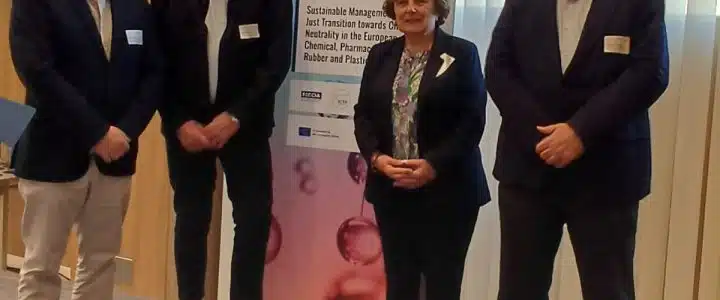
Read moreJustTransLead Conference Malaga

European Federation of Executives in the Sectors of Energy and related Research
The CEC European Managers (Confederation Européenne des Cadres) is deeply committed to a Just Transition towards a decarbonised industry and energy use, ensuring that no worker is left behind.
Read more
European electricity prices are set through a merit‑order system, where power plants are dispatched from the lowest to the highest marginal cost. Renewables such as wind and solar usually come first because their variablecost is close to zero. Nuclear and coal follow, while gas‑fired plants are typically last, as they are the most expensive to operate.
Read more
The ongoing energy crisis, characterized by persistently high gas and electricity prices, is undermining the competitiveness of European industry. Energy‑intensive sectors—particularly the chemical industry—are facing increasing difficulties in competing with regions that benefit from abundant and affordable domestic energy resources. Without decisive action, Europe risks accelerated deindustrialization, job losses, and a lasting erosion of its industrial base.
Read more
Si je vous dis « L’énergie, c’est l’Europe », vous pensez à la Communauté Européenne du Charbon et de l’Acier ?
Aux manifs antinucléaires ?
A la fermeture de la centrale nucléaire de Fessenheim ?
Aux éoliennes et aux panneaux solaires importés de Chine ?
Aux gaz verts produits localement ?
Au conflit russo-ukrainien ?
A notre indépendance stratégique et industrielle ?
Au dérèglement climatique ?
A la pollution atmosphérique ou à la neutralité carbone ?
Aux immenses enjeux géostratégiques mondiaux ?
A votre facture d’électricité et de gaz ?
FECER (Fédération Européenne des Cadres de l’Énergie et de la Recherche) held its annual general meeting in Madrid at the invitation of the Spanish trade union CCP – Confederación de Cuadros y Profesionales. Spanish energy policy and last spring’s blackout in Spain and Portugal were the main topics of discussion.
Read more
The Fédération Européenne des Cadres de l’Énergie et de la Recherche (FECER) supports the Independent Trade Union of Ignalina Nuclear Power Plant (ITU INPP) in its call for employee representation on the INPP board. Aligning with European best practices, we emphasize that employee participation in governance strengthens transparency, improves decision-making, and upholds the principles of social partnership across the European Union. Given that the Lithuanian INPP decommissioning project benefits from EU funding, integrating employee representation would demonstrate a strong commitment to inclusive and collaborative corporate governance.
Read more
The FECER (Fédération Européenne des Cadres de l’Energie et de la Recherche) held its 2024 General Assembly in Alsace. FECER, one of the components of the CEC European Managers, once again placed the reality on the ground with a site visit at the heart of its reflections and positions on European energy policy.
Read more
The EU currently counts around 10 million managers who make millions of decisions every day, affecting the sustainability of our economy, society, and environment. Millions of decisions are made daily concerning employees on, for instance, recruitment, appointments, regulations, and dismissals. All decisions are made with careful consideration in the interest of the company, the context, and the task at hand.
Read more
The European Federation of Executives in Energy and Research (FECER) is calling for consideration to be given to the full range of possibilities in research and development and in the construction and operation of low-carbon energy production facilities. This demand echoes not only the motto of the European Union « United in diversity » but also the geographical, political and historical facts of our continent.
Read moreFECER President Anne Laszlo recently visited Confcuadros (Confederation de Cuadros y Profesionales, CCP) in Madrid. She met with the President and Secretary General of the Confederation of Spanish managers, and the new President of its Energy Federation, Álvaro Muñoz at the CCP headquarters.
Read more